Language matters in AI image prompting, but its influence is often smaller than the clarity of the instructions, the visual detail, and the capabilities of the model. In Roku Studio's analysis, prompts with equivalent meanings in several languages produced relevant images without significant changes that could consistently be attributed to language alone.
This finding does not mean that every language will always produce identical results. A more accurate conclusion is that modern AI image models can understand many languages for common concepts, while differences are more likely to appear with technical terms, cultural context, text inside images, or models with limited multilingual support.
Does prompt language affect AI image results?
Prompt language can affect the result, but it is not always the main factor. For common visual requests involving a subject, setting, lighting, camera angle, and style, modern models can often understand the same intent in English, Indonesian, and other languages.
Roku Studio's test published on Instagram used prompts with equivalent meanings in Indonesian, Mandarin, English, and Hindi to generate an advertising key visual for a product launch. The results remained relevant to the original direction, with no major difference that could consistently be attributed to language choice alone.
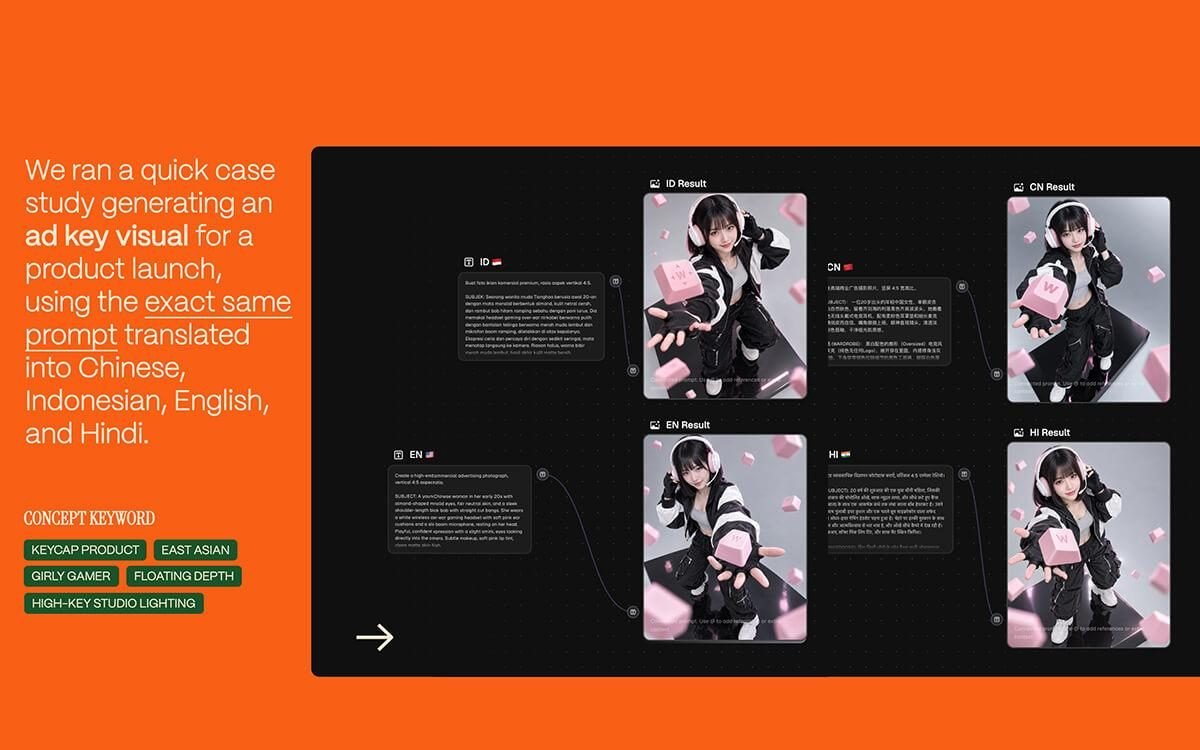
However, a single generation is not enough to prove that several languages perform equally. Image generators are variable. Two images created from the same prompt can differ because of sampling, model settings, or automatic prompt enhancement within the system.
Our observation should therefore be understood as a practical finding, not a universal rule for every model and every language.
Why can different languages produce similar images?
AI image models map words, relationships between concepts, and prompt context into visual representations rather than matching sentences to images literally.
Research on multilingual text-to-image models shows that language support can be expanded through multilingual text encoders and concept alignment. For example, the AltDiffusion study introduced a model supporting 18 languages and evaluated its ability to understand both general and culturally specific concepts.
For a concept such as “a barista in a minimalist café with morning light,” the visual intent is relatively clear. If a translation preserves the subject, context, and style, a model that supports both languages is likely to generate images that are similarly relevant.
Prompt clarity matters more than choosing English
A clear prompt is usually more useful than an ambiguous prompt written in English. Google's Imagen prompting guide identifies the subject, context, and style as core prompt elements and recommends iteration to move closer to the intended result.
The following structure can be used in any language:
- Subject: Who or what should appear?
- Action: What is the subject doing?
- Context: Where does the scene take place?
- Composition: What viewpoint and arrangement should be used?
- Lighting: What kind of light is needed?
- Visual style: Should it be a photograph, illustration, collage, 3D render, or something else?
- Constraints: What must not appear?
An unclear prompt:
Make a nice coffee image.
A more directed prompt:
Product photograph of a cup of milk coffee on a dark wooden table, shot from a 45 degree angle, with soft morning light from the left, a minimalist café background, warm colors, a clean composition, no people, and no text.
The second example is more likely to improve the result because it contains fuller visual information, not simply because of the language being used.
When does language choice begin to matter?
Language is more likely to affect a result when the prompt contains hard-to-translate meanings, rare terminology, or highly specific cultural references.
1. Technical terms and industry vocabulary
Terms for lenses, lighting techniques, art movements, or production processes may be recognized more reliably in the English vocabulary commonly used by an industry. If a local term produces a weak interpretation, keep the more precise technical term without translating the entire prompt.
2. Local cultural concepts
Words such as “warung,” “kebaya,” or the name of a specific tradition carry context that may be weakened by a generic translation. For a cultural concept, the local term can provide a more accurate signal when it is followed by a visual description.
A woman wearing a kebaya kutubaru, a traditional Javanese blouse with a front fabric panel, photographed on the terrace of a tropical colonial house.
3. Text that must appear inside the image
When an image must contain a title, slogan, or label, language and spelling become more sensitive. Although image models continue to improve, Imagen's documentation still recommends keeping text short and generating several iterations to obtain a clean result.
For branded material, final text should still be checked and rebuilt in a design application so spelling, typography, and information hierarchy can be controlled.
4. Language support varies by model
Not every image generator has the same language capabilities. AltDiffusion was developed because many earlier models supported only a limited number of languages well. A result from one model therefore does not automatically apply to another.
5. Translation can change the intended meaning
The problem is often not that a model fails to understand a language, but that a translation removes important detail. Words that seem broadly equivalent may not carry the same visual nuance.
For example, “moody lighting” is not always adequately translated as “dark lighting.” It can refer to a dramatic atmosphere, directional contrast, strong shadows, and a particular emotional palette.
Are English prompts always better?
English prompts are not always better. English can help when a particular model is stronger with English vocabulary or when the most precise visual terminology is commonly used in English. However, forcing a prompt into English can make it worse when the writer cannot describe the idea precisely.
A more effective approach is to write in the language that best expresses the idea, while preserving technical terms in whichever language makes them most accurate.
In other words, a clearly structured Indonesian prompt can be more effective than a vague English prompt.
How to test the effect of language fairly
A language test must control other variables so language differences are not confused with ordinary generative variation.
- Use the same model and version.
- Keep the image ratio, quality, and other settings unchanged.
- Use the same seed when the platform provides one.
- Translate meaning, not just individual words.
- Generate several results for each language.
- Evaluate subject accuracy, composition, style, cultural detail, and text separately.
- Record terms that fail or shift in meaning.
Without these controls, a difference between two images may come from normal generation variability rather than language.
A multilingual prompting strategy for creative work
The best strategy is not to choose one language for every situation, but to use language functionally.
Use the team's main language to write a complete direction. Keep technical terms in the language that expresses them most precisely. For cultural concepts, use the local term and add a visual explanation. When a result is not right, change one prompt element at a time so the cause of each change can be tracked.
This approach aligns with the importance of art direction. As explained in Roku Studio's article about AI slop, prompting, and art direction, visual quality does not depend only on the tool or the wording of a prompt. It also depends on the ability to choose references, direct the composition, evaluate output, and iterate.
Conclusion
Language matters for AI image prompting, but it does not always determine the quality of the result. Roku Studio's analysis shows that several languages can produce relevant images when the meaning of each prompt is clear and equivalent.
The factors that more consistently affect results are subject clarity, context, composition, style, lighting, constraints, and model capability. Language becomes more important when a prompt uses technical terms, cultural concepts, text inside an image, or vocabulary that a model supports poorly.
You do not need to translate every prompt into English. Use the language that makes the direction most precise, then test the result under controlled conditions.
Frequently Asked Questions
Can AI image models understand Indonesian prompts?
Yes. Many modern AI image models can understand Indonesian prompts for common concepts. Quality still depends on the model's capabilities, the clarity of the instructions, and how specific the requested concept is.
Do English prompts produce better images?
Not always. English may help with certain technical terms or models with limited language support, but a clear Indonesian prompt can be more effective than an ambiguous English prompt.
Why do images differ when the prompt is only translated?
Differences can come from random variation, a translation that changes nuance, the way a model processes each language, or automatic prompt enhancement. Compare several results under the same settings before concluding that language caused the difference.
References
- Ye, Fulong, and colleagues. AltDiffusion: A Multilingual Text-to-Image Diffusion Model.
- Google Cloud. Prompt and image attribute guide for Imagen.
- OpenAI. Image generation guide.
- Roku Studio. AI prompt comparison in Indonesian, Mandarin, English, and Hindi, Instagram.