Before we go further, let's align on the definition. A lifestyle product here means something that adds value beyond its basic function: prestige, identity, or a personal statement for whoever carries it. Sneakers, watches, branded bags, all fall into this category. Over the past three years, one item once dismissed as unremarkable joined that category too: the tumbler.
Disclaimer: the data and analysis in this piece are compiled from dozens of sources (full list under Sources), not unfounded opinion.
Look around any coffee shop, workspace, or car, and there's usually one object sitting there: a tumbler, in a particular color and brand, sometimes even a conversation starter on its own. This didn't happen by accident. Several factors overlap and reinforce each other, and we'll break them down one by one with supporting data.
It All Started With a Running Boom
The starting point of this phenomenon comes from sports, running specifically, not fashion. That's not a baseless claim: the data on running trends in Indonesia shows a real spike.
Compared to January 2024, when around 56,000 runners were recorded, the number of runners in Indonesia jumped roughly 330% to 242,000 by May 2025. Throughout 2024 alone, running activity in Indonesia was logged over 5.6 million times, and participation in running clubs or communities rose 83% that year according to Strava. Running has turned into a social activity, not just something people do alone on a track.
The boom is even across age groups. Indonesia's Central Statistics Agency (BPS), in its 2024 Social Culture Statistics, recorded that 37.16% of respondents aged five and up engaged in physical activity at least once a week. Throughout 2024, 257 running events were held across Indonesia, up more than 60% from the year before, with Gen Z and millennials dominating participation at a 2:1 ratio. A similar pattern shows up globally: running club participation worldwide rose 59% in 2024, and micro-workouts under 20 minutes now make up more than 20% of all physical activity globally, helping people sustain a routine. Across generations, from boomers to gen-z, everyone got swept into the same current, a movement far broader than just young people chasing FOMO.
This is where the tumbler enters the picture. Once running shifted from a sport into a lifestyle, everything around it leveled up too: running shoes became identity markers, running outfits became something to photograph, and the tumbler, once just a water container, turned into part of the active-lifestyle kit. Stylish outfits, finisher medals posted online, post-run selfies, all of it built running's image as a social lifestyle. The tumbler became one of the required props in that visual narrative.
Why This Trend Spread Faster Than Other Fashion Trends
The question is, why did the tumbler trend spread so much faster than, say, limited-edition watches or sneakers? The answer lies in how social media works.
The clearest case study comes from the US, through the Stanley Quencher phenomenon. Stanley's annual revenue jumped from around $75 million to $750 million in a short span, nearly a tenfold leap in four years. The driver was organic user content, not a massive ad campaign. The hashtag #StanleyTumbler alone has racked up billions of views on TikTok, from unboxing videos to styling tips that treat the tumbler like a fashion accessory. Its biggest momentum came through #WaterTok. One viral video of a tumbler that survived a car fire, with the ice inside still intact, hit 92 million views and 9 million likes. Sales of the tumbler climbed 751% year-over-year at the peak of the trend.
Indonesia has its own local version of this. A tumbler from coffee shop Tuku, priced at Rp250,000, suddenly became a national talking point after it was used by a figure named Anita in a viral video. The exact same pattern as the Stanley case played out here: one organic social media moment, then demand exploding within days.
This actually makes sense the more you think about it. Compared to shoes or watches, a tumbler gets far more screen time in everyday content: on a desk during a "working from cafe" video, in hand for an OOTD post, in a car's cup holder during a road-trip vlog.
The Brands That Caught This Momentum
Seeing demand this big, brands started taking the aesthetics of tumblers seriously, not just their function. Here are five brands that captured the most momentum globally, if we map it out.
The initial spark was Stanley, through its Quencher line, which shifted people's perception of the tumbler from a plain drinking vessel to a status symbol. Corkcicle, on the other hand, positioned itself as the aesthetic player, with the widest color range in its class and a photogenic design suited for a desk or a coffee shop table. Hydro Flask remains a favorite among young people for its durability and color variety, even though it started out more associated with outdoor activities. Newer names like Owala have also gained traction, often mentioned alongside Corkcicle in TikTok's tumbler trend lists. Starbucks rounds out the list in its own way, with limited editions and collector series that regularly trigger queues at every release.
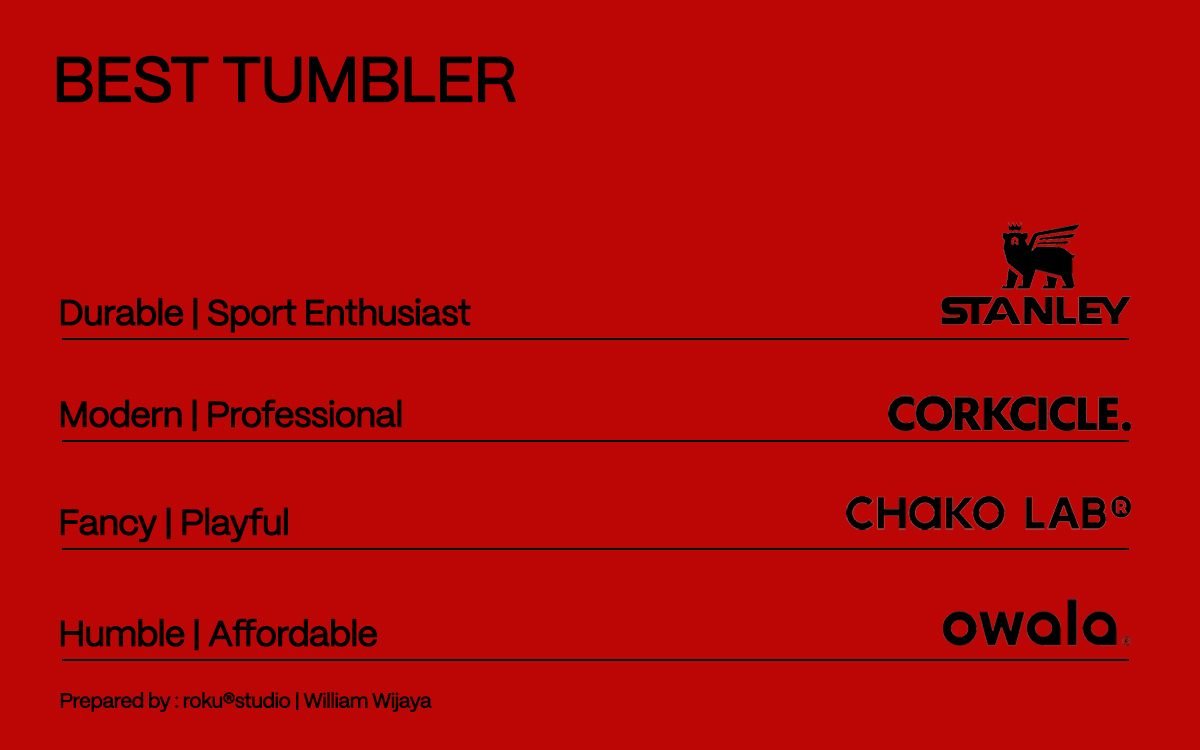
This momentum has been claimed by local names too. Tuku is the most iconic, having gone viral nationally through the Anita moment, proof that even a Rp250,000 tumbler can become a national talking point. A sleek design and the ability to hold cold temperatures for up to 25 hours earned Fore Coffee its spot in the spotlight. Through collaboration editions, from Tahi Lalats to One Piece to BTS themes, Kopi Kenangan turned its tumblers into collector's items. Eiger, Indonesia's legendary outdoor brand, targets a different segment altogether: active consumers who love outdoor activities. Stein rounds out the list as a local player with modern design and flexible sizing for the everyday urban youth market. Then there's Chako Lab, which took a different path from Corkcicle's luxury-leaning aesthetic, Chako Lab wins instead through the cutest, most playful designs in its class, aimed at people looking for a tumbler as an adorable statement, not a luxury one.
Stanley's first official store in Indonesia opened at Grand Indonesia, followed by Corkcicle at Plaza Senayan. That's a sign local market interest in these brands is serious, far beyond a passing social media trend.
The business numbers back this up too, this isn't empty hype. Globally, the reusable water bottle market was valued at $9.47 billion in 2024 and is projected to grow to $13.77 billion by 2033 at a 4.25% CAGR. Asia Pacific holds the largest market share, around 40.2% of global revenue in 2025. This category carries real commercial value, not just buzz that fades once the trend moves on.
Why Tumblers Beat Shoes as a Lifestyle Item
There's one structural advantage that makes tumblers an easier lifestyle item than a category like shoes. Like it or not, shoes are tied to specific functions: there are running shoes, futsal shoes, basketball shoes, work shoes, each with its own design and market. Running shoes aren't comfortable for basketball, and formal work shoes aren't an option for a workout.
Tumblers don't have that limitation. The same tumbler can go to the office, to the gym, to a coffee shop, all the way to a road trip. Because its function is universal, a single tumbler shows up in more moments and more content than shoes, whose segmentation is far narrower. That's part of why a tumbler's lifestyle value spreads more easily, it isn't boxed in by any single occasion.
A health-conscious lifestyle spreading across generations lit the fuse. Social media accelerated it through exposure that wasn't even intentional. And its universal function makes the tumbler relevant in nearly every daily activity. All three converged at the right moment, and that's what lifted the tumbler into one of the most prominent lifestyle products of the 2020s.
Written by William Wijaya
Sources
Cyclopedia, Mengupas Tren Lari di Indonesia 2024. RRI.co.id, Lari Jadi Tren Olahraga Favorit Masyarakat Indonesia 2025. Republika (Ameera), Strava Rilis Laporan Tren Olahraga 2024. GoodStats, Peningkatan Tren Lari di Indonesia. Tabloid Pulsa, Global Running Day 2025: Garmin Connect. Fimela, Event Lari: Tren Hidup Sehat atau FOMO bagi Gen Z? Sinar Kaltim, Tren Lari Kian Populer. Liputan6, Event Lari, Antara Tren Sehat atau Ikut-ikutan. Press Strava, Year in Sport Report. Forbes (Marcus Collins & Conor Murray), Stanley Cup Craze. Blavity, How TikTok Fueled The Stanley Cup Craze. TIME, Why a New Stanley Cup Is Causing a Frenzy at Target. Amra and Elma, Top 20 Stanley Cup Marketing Statistics 2025. Thursday Twelve O'Clock (Substack), Stanley Cups Keep Going. Detik Wolipop, Fenomena Tren Tumbler dan Obsesi yang Mengancam Lingkungan. Detik Wolipop, Adu Tumbler Premium Rp 400 Ribuan. Pilipili, Corkcicle Indonesia: Panduan Lengkap 2026. FIN.co.id, Rekomendasi Tumbler yang Sedang Tren di TikTok. GoodStats, Top 10 Brand Tumbler Favorit di Indonesia. Suara.com (YourSay), 4 Rekomendasi Tumbler dari Jenama Kopi Lokal Indonesia. Grid.id, 5 Rekomendasi Tumbler Lokal 2025. Straits Research, Reusable Water Bottle Market Report. Grand View Research, Reusable Water Bottle Market.